Also published on our Substack: https://rodrigoguzman.substack.com/p/your-ai-rollout-runs-through-a-handful
Your AI rollout runs through a handful of your managers
Whether an AI investment pays back depends less on the technology than on how people work with it, and that is decided, team by team, by their managers. AI is also changing what we should expect from those managers.
Picture a CEO who has just signed a large AI contract. Sooner or later, the board will ask whether it paid back. Most companies organize their rollout as if the answer depended on the technology: IT deploys the tools, HR runs the training, and everyone waits for the productivity gains to show up in the numbers.
Our data points somewhere else. In the sales force of a global consumer-goods company, about 20,000 people had access to the same digital tools and the same training. Yet the people who used those tools the way the best teams do were concentrated under a small group of managers: 56% of the sales reps who met the best teams’ standard reported to just 13% of the supervisors. The tools were the same for everyone. What differed was how each team worked with them, and that depended largely on who led the team.
This essay makes three arguments, one per section:
- The return on AI is decided by behavior, and behavior is shaped by managers. Our data shows this across very different companies, and it also shows what the best teams do differently.
- AI is changing the manager’s job in a fundamental way. As machines take on more of our cognitive work, the human contribution that remains depends on emotions. Management will have to learn to handle the emotional side of work as rigorously as it handles budgets.
- This leads to four practical decisions for any CEO or general manager rolling out AI today.
All three rest on one idea: every management decision is a bet on how people will behave. An AI contract is the largest such bet most companies will place this year.
1. Same tools, very different results
How we compare teams
To understand why some teams get far more out of their tools than others, we compare a company’s best teams with the rest. “Best” doesn’t mean the teams with the highest raw numbers. A team selling in a wealthy city can post strong results while underperforming its market, and a team in a difficult territory can post modest results while beating it. So we first remove the effect of external factors, such as local economic conditions and demographics, and then compare each team with the potential of its own market. The best teams are the ones that perform furthest above that potential.
What we found in one sales force
In the consumer-goods sales force, we took the top 20% of distribution centers by sales growth and measured how often their people used key functionalities in the digital tool. That frequency became the standard for each role. Then we checked how many people across the whole sales force met it.
Three out of four route executives did (74%, using the CRM and analytics daily). Four out of ten supervisors did (40%, reviewing their analytics dashboard every week). Among sales reps, the role closest to the customer, only 3.5% did (12 or more store evaluations a week). And the reps who did meet the standard were not spread evenly across the company: more than half of them worked for just 13% of the supervisors.
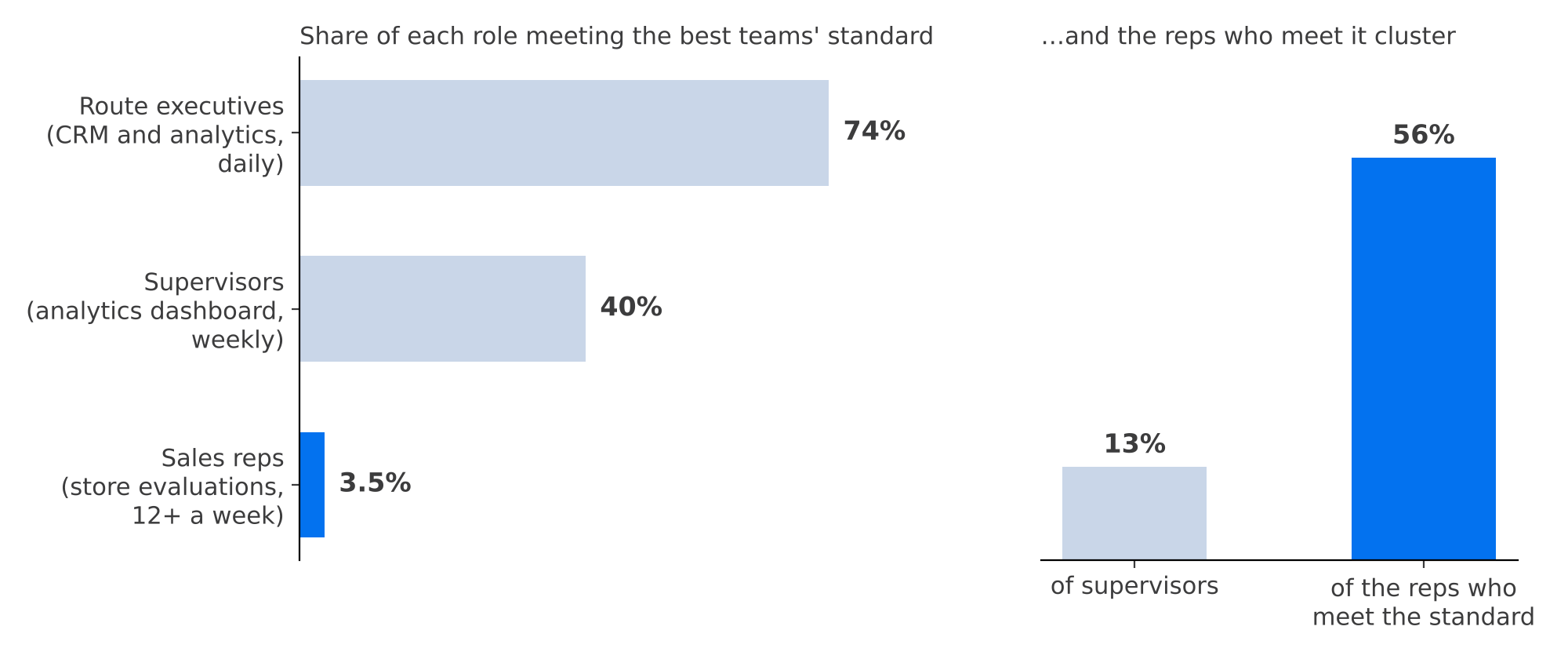 Share of each role meeting its standard: how often the best teams (the top 20% of distribution centers by sales growth) use each tool. A global consumer-goods company, sales force of about 20,000 people, 2025. Source: Hubble_s analysis.
This is what a technology rollout looks like from the front line. A new tool doesn’t spread evenly from a launch email or a training program. It travels through a few managers whose teams already work differently, and it stalls in the other teams.
Two classic thinkers would have expected this. Andy Grove, Intel’s former CEO, argued in High Output Management (1983) that a manager’s output is the output of the organization they manage, plus that of the neighboring organizations under their influence. The sociologist Everett Rogers showed in Diffusion of Innovations (1962) that new practices spread through opinion leaders: the people others watch before deciding whether to adopt something new. At work, the opinion leader most people watch most closely is their direct manager.
What the best teams do differently, across seven analyses
We wanted to know whether this pattern holds beyond one company, and what exactly the best teams do differently. So we compared seven analyses built the same way: two sales forces and a manufacturing plant of the same consumer-goods company, and the medical sales teams of a global healthcare company in Europe, the Middle East, Africa and South-East Asia. In each one, we looked at how teams use their digital tools and at how they work together day to day.
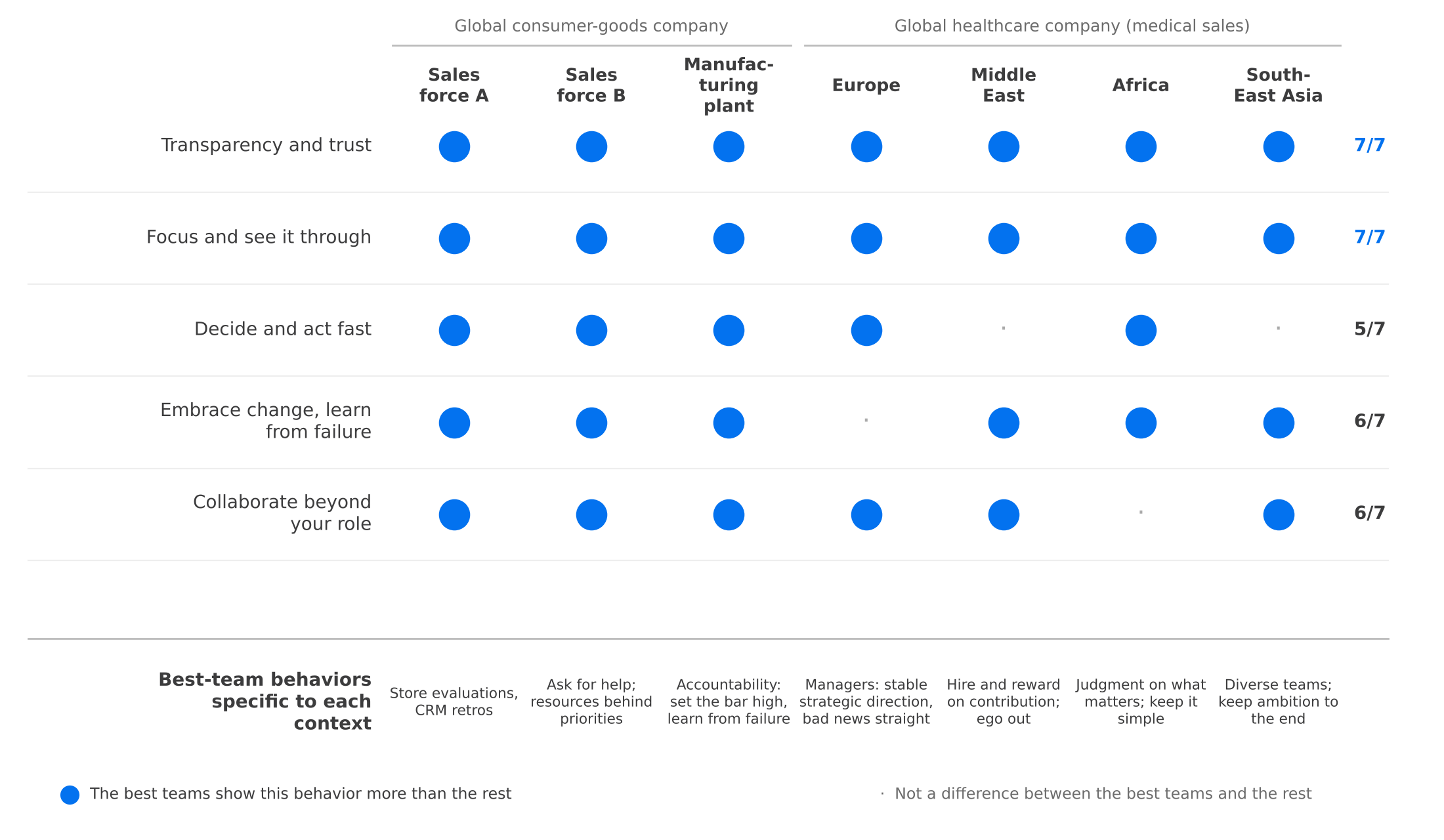 Behaviors that separate the best teams from the rest once external factors are removed, in seven perform-to-potential analyses (2024–2026): two sales forces and a manufacturing plant of a global consumer-goods company; medical sales teams of a global healthcare company in four regions. The bottom row shows behaviors that set the best teams apart only in that context. Source: Hubble_s analysis.
Three findings stand out.
A small core of behaviors separates the best teams everywhere. Two appear in all seven analyses. The first is transparency and trust: people say what they think and what is going wrong, admit their mistakes, ask for help early, and experts share their opinion even when they aren’t certain. The second is focus: concentrating time and resources on a few priorities and seeing them through when difficulties arise. Most of the seven analyses also point to two more: moving quickly from discussion to decision to action, and treating change, and even failure, as an opportunity to learn.
Each context adds its own behaviors on top of that core. In the manufacturing plant, the most important group of behaviors was accountability: setting a high bar for quality and learning from every experience, failures included. In the European sales teams, what set the best teams apart was how their managers led: they gave a clear strategic direction, kept it stable, left the details of execution to the people doing the work, and delivered bad news honestly. In South-East Asia, the best teams had been built deliberately with diverse profiles, and they kept the ambition of their projects intact through the final phase instead of scaling it back. In the Middle East, people were hired and rewarded on what they actually contributed. Even the digital part of the standard was local: of dozens of features in each tool, the best teams stood out on a handful, and the handful was different every time.
The best teams don’t know the tools better. In the medical sales teams in Europe, 95% of the people in the best teams said they knew how to use the tool, against 92% in the other teams. Their technical proficiency was practically the same. The difference lay in how they worked together.
Taken together, these findings explain why managers matter so much. The behaviors that turn a tool into results (being transparent, focusing, deciding, learning) are not taught in a training session on the tool. They develop inside teams, and they depend heavily on the person who leads each team.
2. AI is changing what management is
What a manager is for
To see why managers have so much influence, it helps to be precise about what a manager is for. We read Grove’s idea as describing two distinct roles.
The first role is strategic: deciding how many resources the unit needs, finding them, and choosing where to put them. For a company, this means deciding which markets to compete in, which projects to fund and which tools to buy. Signing an AI contract, rather than investing the same money elsewhere, is a strategic decision.
The second role is management in the narrow sense: getting the most output from the resources you have. Here, the variable that makes the biggest difference is rarely the amount of resources, such as the number of vehicles, computers or licenses. It is what people do with them. Two teams with identical resources can produce very different results, and the gap almost always comes from how they behave: how they prioritize, decide, cooperate and react to setbacks. That is why we describe the core of a manager’s job as influencing how the team behaves.
An AI tool is one more resource the company has paid for, and its return depends on how teams use it. Once the contract is signed, the main question is no longer about technology; it is about behavior. And behavior, as we have seen in more than ten years of work with large companies, is a reaction to a context: people behave according to the priorities, rules, incentives, routines and examples around them. The manager shapes much of that context for a team. That is why a handful of managers can carry, or stall, an entire rollout.
What machines take over, and what remains human
There is a broader point here, and in our view it is the most important one in this essay. AI doesn’t only raise the stakes of good management. It changes what good management is.
Each industrial revolution has taken over a human capacity. The machines of the 19th century replaced human muscle, and much of 20th-century management was about organizing physical work efficiently. Computing, and now AI, is taking over a growing share of cognitive work: analyzing, calculating, writing, summarizing, even reasoning through problems. As that happens, the value people add moves towards what machines don’t do.
What remains is closely tied to emotions. The qualities that commentators now say people must bring to work all depend on how we experience and channel our emotions: creativity, the ability to influence others through empathy, the courage to make decisions that don’t look rational at first, and the persistence to keep going when things get hard.
Emotions also drive everyday behavior at work. When they are channeled well, they produce productive behaviors, like the transparency, focus and willingness to learn we found in the best teams. When they are channeled badly, they produce what we call Frictions: unproductive behaviors, such as blaming others, avoiding decisions or giving up after a setback, that slow teams down and frustrate the people in them.
The third stage of management
This is why we believe management is entering a third stage.
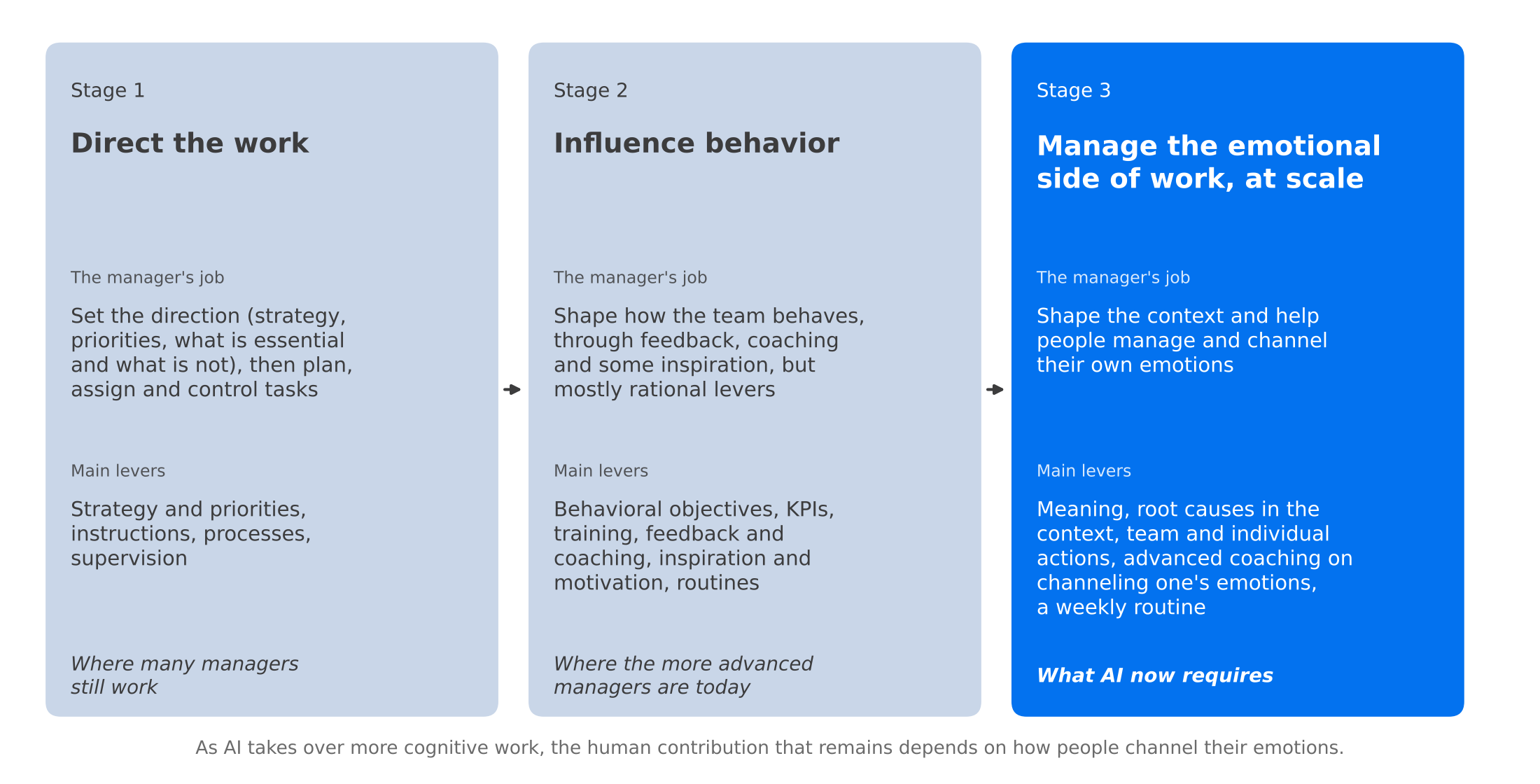 Source: Hubble_s.
In the first stage, the manager’s job was to direct the work: give the team a direction (the strategy, the priorities, what is essential and what is not), then plan, assign and control the tasks. Many managers still work this way.
In the second stage, managers understood that their real job is to influence how people behave, and they started to use the levers that do so: behavioral objectives, KPIs, training, feedback and coaching, team routines, and the ability to inspire and motivate. That is real progress. But even at this stage, most managers rely mainly on rational levers: they explain, set targets, measure and give feedback.
The third stage, which AI now makes necessary, is to manage the emotional side of work, and to do it systematically and at scale rather than through the instinct of a few gifted leaders. Some managers have always done this well by intuition. What has been missing is a method that any manager can apply.
That method starts with the context, not with the individual. With the same emotions, a better context makes the right behavior easier: clear priorities, fewer contradictory demands, a safe space to admit mistakes. So the first step is to set clear behavioral objectives. The second is to identify the root causes in the context that push people towards those behaviors or away from them. The third is to give teams and individuals concrete actions to manage their own reactions to that context, including advanced coaching that helps each person manage and channel their own emotions. Because changing a habit takes many repeated positive experiences of the new behavior, this work has to happen every week, not in a one-off workshop.
For a CEO rolling out AI, this is a practical matter. Adopting AI asks people to change how they work, to accept some uncertainty about their role, and to trust a tool they don’t fully understand. Those are emotional reactions as much as rational ones. A manager who explains the tool and sets usage targets is working in the second stage. The rollout needs managers working in the third.
3. Four decisions for the leader who signed the contract
What does this mean in practice? We see four decisions for the CEO or general manager, in this order.
Decision 1: Give the rollout a meaning people can believe in
The first decision is about the story. Teams adopt a tool when they understand why it matters, for the company and for themselves. If they believe AI is about following a trend or cutting headcount, they will resist, often quietly. So the CEO’s first task is to explain how AI fits into a vision of the company’s future that makes sense to its people: what the company will be able to do, and what their own work will become. This is qualitative work, done in conversations with teams more than in spreadsheets with the CFO. Without it, every other part of the rollout struggles. If we were in the CEO’s position, this is what we would work on next Monday.
Recent survey data supports this. BCG’s latest AI at Work survey (June 2026, close to 12,000 respondents) found that 74% of frontline employees now use AI every day or a few times a week, up 23 points in a year. Yet only a third of them say leadership’s communications about AI are clear, and only 28% see a strong connection between what leaders say and what the organization actually does. BCG also found that employees with a clear strategy but limited access to tools outperform those with strong access but no direction. The year before, the same survey found that frontline employees’ positive feelings about AI rose from 15% to 55% when leaders strongly supported its use, and that only about a quarter of them received that support.
Decision 2: Give each part of the rollout the right owner
The second decision is about ownership. We see three owners, each responsible for a different part of the rollout.
- IT owns the technical deployment: the tools work, they are integrated with the systems people already use, and the spending is tracked.
- HR owns the human deployment: people understand the tools, are trained to use them well (including the judgment AI requires), and work in a context that makes the right behaviors easy to adopt.
- The general manager owns the result: they connect the rollout to the strategy, break the silos between IT and HR, and keep asking whether AI is improving business results. In a function, this is the head of the function where the tools are deployed.
Getting this wrong has a predictable cost. When IT owns the whole rollout, it tends to run it like a product launch: the tool is available, so people should use it. Users answer that the tool isn’t good enough, which is why they don’t use it. The deployment team answers that an imperfect tool is still useful, so the problem is the users’ attitude. Both sides are partly right, and the organization gets stuck in this loop. We have seen it happen at a global healthcare company. The way out is a business owner who decides what the tool is for and what good use looks like.
HR’s role will grow over time. As AI agents take on more work, HR teams will need to understand AI well enough to weigh in on choices that look technical but are really about behavior, starting with the instructions given to agents, so that agents behave the way the company wants its people to behave.
Decision 3: Measure what AI produces, and find the teams worth copying
The third decision is how to measure progress. Counting logins says little about value. We suggest measuring what AI allows each team to produce, in three categories:
- Improve: doing what the team already does, but better; for example, content with more impact or better-prepared customer visits.
- Automate: doing more of it in the same time; for example, one person producing three times as much content in a week.
- Create: doing things the team couldn’t do before.
Each team should set its own objectives in each category, because a sales team and a finance team will use AI very differently. Each manager also needs a clear hypothesis about how these outputs will improve the outcomes the team is accountable for, its business and people KPIs. Without that link, more output can simply mean more activity.
To spread good practice, the CEO also needs to know which teams are getting it right. A simple way is to place every team on two axes: how well it has adopted the tools, and how well it performs.
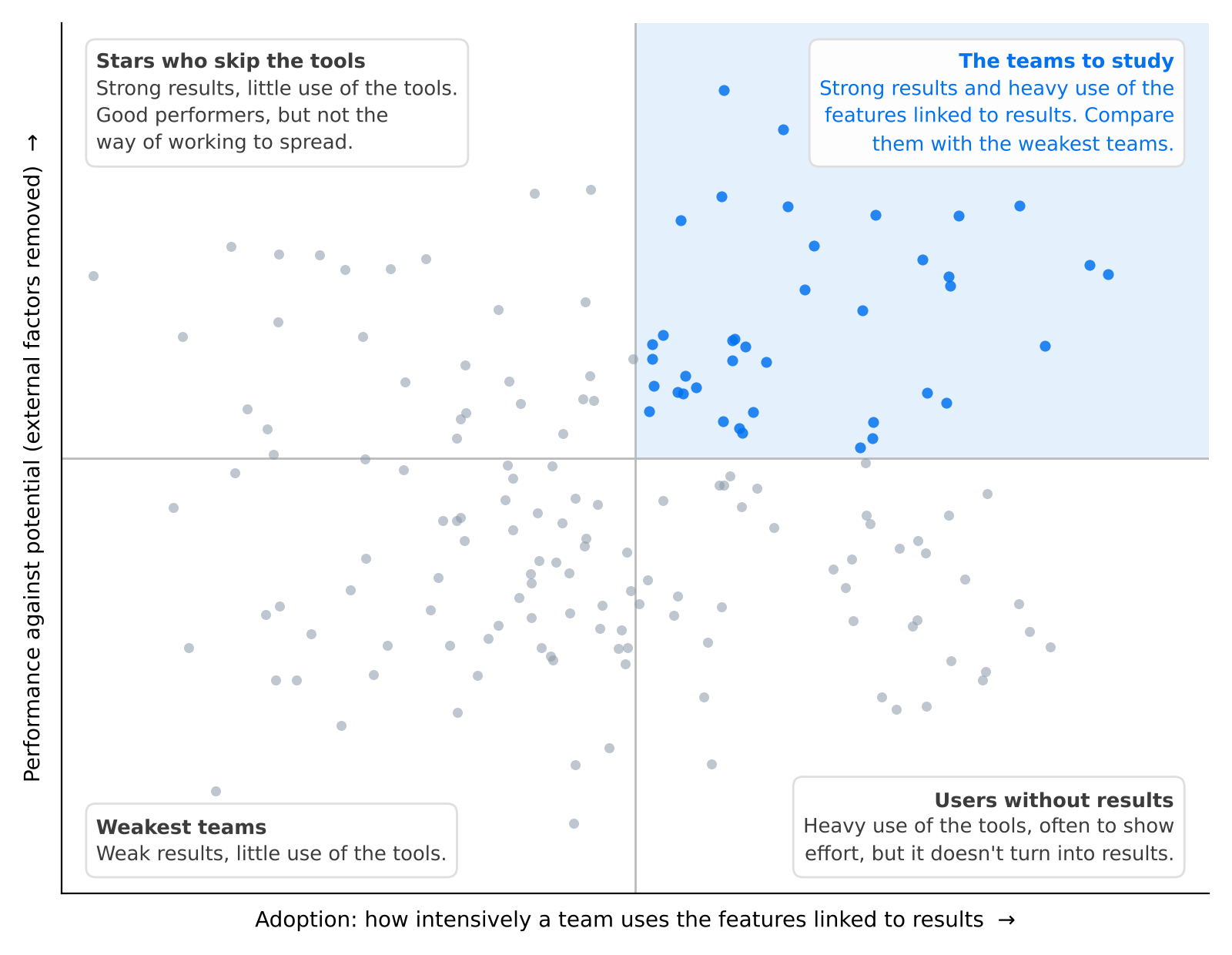 Illustrative: each dot is a team. Adoption is read from how intensively teams use the features linked to results; performance against each team’s potential once external factors are removed. Source: Hubble_s.
Two of the four groups are misleading. Teams with strong results but little use of the tools are often the company’s stars: experienced sellers who ask to be left alone, and are left alone because they deliver. Their results are real, but their way of working is not the one to spread. Teams that use the tools heavily but get weak results are often trying to earn credit with their managers through adoption, because they can’t earn it through results. The teams worth studying combine strong adoption with strong results.
Finding them requires two corrections that most adoption studies skip. First, measure adoption by how intensively people use the specific features linked to results, rather than by how often they log in. Other features may be useful, but they aren’t the ones that pay back. Companies learned this with CRM systems: in the end, what mattered was whether the reps sold more. Second, measure performance against each team’s potential, after removing external factors, as described in section 1.
Then compare the best teams with the worst and look for what the best do differently, because much of what the best teams do, the worst teams do too. And look beyond the manager. The manager is an important part of a team’s context, but so are its rituals and routines, its priorities, its decision rights and its incentives. Those root causes are what make the right behaviors easy or hard to adopt.
Decision 4: Judge the return over several years
The fourth decision concerns the return itself. Most companies judge an AI investment within the year: how much did we spend, and how much did we get back by December? That frame misreads the investment, for two reasons. AI is improving very fast, probably faster than most companies can absorb it. And only a small minority of users get close to the full capability of today’s tools. A company that holds back, or judges each tool on its first-year payback, will fall further behind every quarter against competitors whose teams are learning.
The move from horses to cars is a useful comparison. For a sales manager at the time, the question that mattered was whether every salesperson was driving while the streets were still full of horses, and whether they drove better than the competitors who were just starting. Whether the first car paid for itself within a year was secondary. The return on AI is best judged the same way: by whether your teams are keeping pace with what the technology can do. Shareholders follow this argument when it is explained to them, and some general managers are already making it. Those who keep looking for a financial return within the year are likely to fall behind.
A bet placed with open eyes
These findings have limits. They come from two companies (more than 30 countries), and the sales-force figures from just one of them. The standard was derived from the top performers in the same data, and strong supervisors may attract strong sales reps rather than create them, so the 56% should be read as a strong pattern until other companies confirm it. The comparison of seven analyses shows correlations between behaviors and results after removing external factors, not definitive proof of cause and effect.
That is the nature of management decisions. They are bets placed with imperfect information, and, as Annie Duke argues in Thinking in Bets, a decision should be judged by the quality of the bet, not only by its outcome. Signing an AI contract is a bet that people will change how they work. The odds improve considerably when a CEO knows which managers will carry the change, gives the rollout a meaning people believe in, and treats the emotional side of work as a core part of management.
Sources. Our data (Hubble_s analysis): a global consumer-goods company, a sales force of about 20,000 people, 2025, where the standard for each role is how often the top 20% of distribution centers by sales growth use each tool; seven perform-to-potential analyses, 2024–2026, in two sales forces and a manufacturing plant of that company and in the medical sales teams of a global healthcare company in four regions. BCG, “AI at Work: Strategy Matters More Than Tools” (June 2026) and “AI at Work: Momentum Builds, but Gaps Remain” (June 2025). Andy Grove, High Output Management (1983). Everett Rogers, Diffusion of Innovations (1962). Annie Duke, Thinking in Bets (2018).
Short version: Why do AI rollouts fail to pay off?